
A specification sheet is a sales document. It is written by the party that wants the order, formatted to be compared against competitors, and rarely states the conditions under which each number was measured. Two suppliers can both print “air pressure 4 kPa” and ship products that feel nothing alike.
This guide covers how to read eye massager specifications: which numbers change the customer experience, how the same figure gets defined differently, and what you can verify with one unit on your desk. It is for importers and private-label buyers comparing quotes.
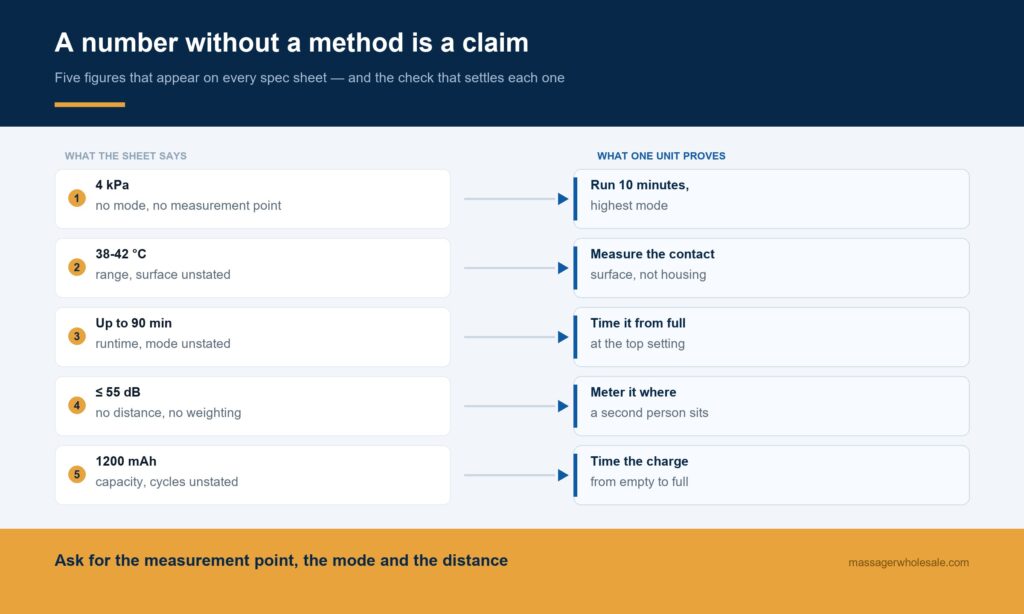
Why two spec sheets for the same product disagree
Most discrepancies are not dishonest. They come from four ordinary gaps.
- Peak versus sustained. Air pressure quoted at its highest moment is not the pressure held for a ten-minute session.
- Measurement point. Housing temperature, contact-surface temperature and setpoint temperature are three different numbers on the same device.
- Mode. Runtime at the lowest intensity and runtime at the highest can differ by a wide margin, and sheets usually quote the favourable one.
- Rounding and “typical”. A range like 3–5 kPa may be a tolerance band, or it may be the spread across units the supplier has measured. Ask which.
The sheet is still useful — as a starting point that has to be converted into questions.
The five numbers that decide repeat sales
These five carry most of the customer experience.
| Parameter | What it changes for the buyer | What to pin down |
|---|---|---|
| Air pressure (kPa) | Whether it feels like firm pressure or a light touch | Peak or sustained; at which of the modes; measured at the airbag or at the pump |
| Heat (°C) | Comfort and perceived quality; weak heat is the most common complaint | Surface temperature reached, time to reach it, and whether it is thermostatically capped |
| Runtime and charge time | How often the customer charges, and how long they wait | Minutes at the highest mode from full charge; hours from empty to full |
| Noise (dB) | Whether it can be used beside another person | dB(A) and the distance measured; at which mode |
| Weight and fit (g) | Whether it stays on without holding, and whether it suits a smaller face | Unit weight with battery; strap adjustment range |
The order in that table matters. Air pressure and heat are what the customer judges in the first minute. Runtime and noise decide whether they keep using it after a month. Weight and fit decide whether they recommend it.
Battery and charging: the part that governs shipping and returns
Battery specifications deserve their own reading, because they affect three things at once: customer complaints, freight paperwork and warranty exposure.
- Capacity is not runtime. A larger cell in a less efficient device can deliver fewer sessions. Ask for runtime at the highest mode, not a headline mAh figure.
- Cycle life sets the warranty tail. A pack rated for a limited number of full cycles will fade inside a one-year warranty if the customer charges daily. Ask what capacity remains at the end of that count, not at the start.
- Charging input must match the market. USB input voltage and the plug type supplied with the unit differ by destination; a charger that does not suit the market becomes a support ticket, not a sale.
- Air freight has its own requirements. Devices with a built-in lithium battery are normally shipped with a UN38.3 test summary and a battery MSDS, which carriers ask for at booking. If a supplier cannot produce both, that is a shipping problem.
Returns concentrate here: units that stop holding charge, units that will not charge, and units whose charger was lost. All three are cheaper to prevent at the specification stage than to resolve afterwards, which is why the warranty terms you agree should reference this sheet.
How to verify a number without a laboratory
One unit, one quiet room and one afternoon will settle most of the sheet.
- Runtime. Charge to full, run at the highest mode with heat on, and record the time until it stops. Repeat once; the second figure is the one to quote internally.
- Heat. Run for ten minutes and measure the contact surface rather than the housing. What the customer feels is the surface against the skin.
- Noise. Measure at the distance another person would sit, not against the device. A phone meter is uncalibrated but consistent — compare units with the same tool.
- Charge time. Discharge fully, then time to full with the supplied charger. A fast-charge claim that needs a third-party adapter is a condition, not a spec.
- Pressure. There is no substitute for wearing it. Have two people of different face sizes try the same unit; disagreement is a fit problem worth solving before the order.
Record every figure with the date and the unit’s lot. That record makes a second order comparable to the first, and it is the same discipline as the quality inspection process, applied earlier.
Where specification inflation shows up
- A pressure figure with no mode attached.
- “Up to” for every performance number and no “at” anywhere.
- Temperature quoted as a range wider than the comfort band.
- Battery capacity in mAh with no runtime claim beside it.
- Noise in dB with no distance and no weighting.
- Certification named without a certificate number or issuing body.
- A spec sheet that cannot be sent as a file, only screenshotted into a chat.
The last one matters: a supplier who will not send a document usually will not send a test report either.
Matching specifications to your channel
The same product is specified differently depending on who resells it, and paying for headroom a channel cannot sell is a common first-order mistake.
| Channel | Specifications that matter most | Where you can trade down |
|---|---|---|
| Chain retail and pharmacy | Heat consistency, noise, packaging and labelling completeness | Number of modes; app features |
| Corporate gifting | Weight, perceived build quality, box presentation | Runtime, since the unit is used occasionally |
| Online marketplace | Runtime and charge time, because reviews mention them first | Premium materials; retail box complexity |
| Distributor and sub-wholesale | Battery cycle life, spare-part availability, lot marking | Custom colour range |
Read it downward and one pattern appears: channels that face the end customer care about numbers customers can measure at home; channels that resell care about what fails six months later.
What to put in your brief
Four items make a quotation comparable: runtime at the highest mode, the heat behaviour you will accept, the market the charger must suit, and whether you need battery documents for air freight. Send those with your quantity and destination; the product specification page shows how a complete sheet is laid out.
FAQ
Why does the same eye massager show different air pressure from two suppliers?
Usually one figure is peak pressure, the other sustained — or they were measured at different points. Ask for the measurement point and the mode.
Is a higher kPa rating always better?
No. Beyond a comfortable band, more pressure reads as discomfort and shortens sessions. What matters is whether it holds pressure for the whole session, not how high it peaks.
How long should the battery last on a full charge?
It depends on mode and heat use, which is why a runtime figure must state both. Ask for minutes at the highest mode, then verify it on one unit before ordering.
Do I need battery documents to ship eye massagers by air?
Devices with a built-in lithium battery are normally shipped with a UN38.3 test summary and an MSDS, and carriers request them at booking. Confirm the current requirement with your freight forwarder before the order is placed.
Can I get a spec sheet before paying for a sample?
A supplier who has shipped the category should have one ready. Treat a refusal as information about the rest of the order.
The sheet is a question list, not an answer
Every figure on a specification sheet is true under conditions the sheet does not state. Your job is to recover those conditions before the money moves: attach a mode to pressure, a surface to heat, a distance to noise, and a cycle count to battery life. Do that once, and every later quotation is measured against a baseline you own instead of a competitor’s PDF.
For quantity, pricing tiers and what changes between stock and OEM orders, see the wholesale programme. To compare a specific configuration, send the requirements through the contact page.