For a gift buyer, the hard part is rarely finding a product. It is finding one that clears four filters at once: it suits people whose tastes you do not know, it lands before a fixed date, it carries a logo without looking cheap, and it costs a number finance will approve.
Corporate eye massager gifts clear those filters more often than most categories. This guide covers what to specify, how customisation is layered, how to work backwards from the giving date, and where quotations hide cost.
Why corporate eye massager gifts clear the usual gifting filters
A gift programme fails on distribution before it fails on taste. One specification has to fit a warehouse team and a regional director, which rules out anything sized or fitted.
- No sizing. One SKU covers the whole list, so a bulk order does not fragment into a size curve nobody can forecast.
- A price point inside gifting budgets. The range is wide enough that one product serves a client thank-you and a staff allocation without changing supplier.
- A desk-side object, not a stored one. A device on a desk is seen by the recipient’s colleagues, which is the only secondary reach a gift generates.
One qualification belongs here, not in the compliance section: these are relaxation devices, not medical equipment. Specify them as lifestyle gifts and keep health claims out of the copy — claims are what turn a simple purchase into a regulated one.
Three buyers, three different briefs
The same product is bought for three different reasons, and a quotation that works for one often fails for another.
| Buyer | What they optimise for | Where the order breaks |
|---|---|---|
| Company buying for staff or clients | Per-unit budget, one delivery address, logo on the box | Artwork approved late; the date slips unnoticed |
| Gift distributor or agency | Margin, sample speed, ability to re-badge | Supplier treats it as a one-off and goes quiet after delivery |
| Promotional products reseller | Low unit cost, short turnaround, large imprint area | Packaging left out of the quote, added at invoice |
Buy from a supplier that has shipped this category, not a generalist learning on your order. The supplier selection criteria apply, plus one question: what share of their output is gifting?
What customisation actually covers
Customisation is three layers, not one decision, and each moves cost, minimum quantity and lead time.
Layer 1 — stock unit, custom outer packaging. The device is unchanged; the box and sleeve carry the artwork. Fastest route, and where most programmes should start: only the print run is new.
Layer 2 — custom packaging, printed manual, logo on the device. Logo on the housing or control face, co-branded manual, purpose-built box. Lead time grows because print approval and a physical proof sit on the critical path.
Layer 3 — full custom. Colour, housing finish, box structure, accessories and language versions all change. This is a development project, not an order. The OEM and ODM process describes what it requires before a quotation is meaningful.
The rule: pick the lowest layer that still looks deliberate in the recipient’s hands. Layer 3 suits programmes that repeat annually, not a single December shipment.
Work backwards from the giving date
Gift orders do not fail in production. They fail in the weeks before it, when artwork sits in an inbox and a sample waits for a courier.
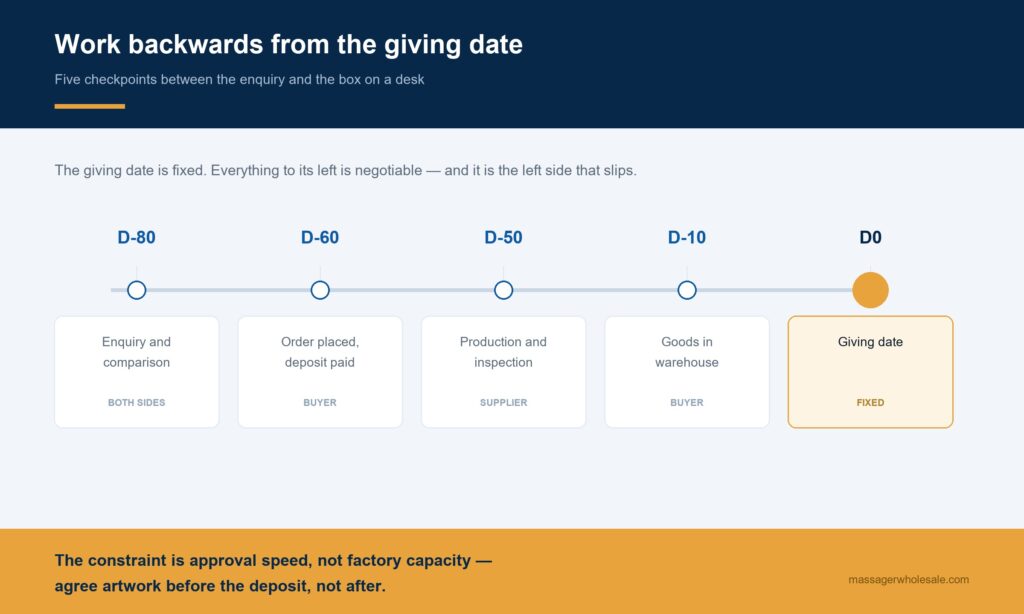
- Giving date, D0. Fixed. Everything else derives from it.
- D-7 to D-10, goods in warehouse. Leave a buffer for clearance; a programme that depends on same-week clearance has a known failure date.
- D-30 to D-40, shipment. Sea freight to Southeast Asia is measured in weeks, not days; transit depends on the port pair.
- D-50, production complete and inspection passed. The last point where a quality problem can still be fixed inside the schedule.
- D-60, order placed and deposit paid. Q4 slots fill early; a late deposit means a later slot whatever the quotation said.
- D-70, sample approved. Artwork, print proof and a physical sample all sign off here.
- D-80, enquiry and comparison. Enough room to change supplier once without losing the date.
Two conclusions follow. The constraint is usually approval speed on the buyer’s side, not factory capacity. And under eight weeks out, the honest options are a simpler customisation layer or air freight — not a promise that the plan survives.
The number that matters is cost per gift received
Unit price is the number everyone compares and the one that misleads most. What a programme spends is the cost of each gift that reaches a desk in working condition.
| Cost line | What it covers | Why it is underestimated |
|---|---|---|
| Unit price | Device and stock packaging | Quoted at the lowest tier the supplier will accept |
| Customisation and tooling | Print plates, box structure, proofs | Added after the unit price was approved |
| Freight | Sea or air, plus insurance | Quoted per carton, planned per person |
| Duty and taxes | Import charges at destination | Left out because the quote stops at the port |
| Shrinkage and spares | Damaged, misprinted or short units | Nothing budgeted until the first shortfall |
Divide the total by the gifts that arrive intact, not the number ordered. A supplier quoting five per cent lower and delivering two per cent damaged is the more expensive option — a gap that only shows after the event.
Compliance does not stop being a requirement because it is a gift
A gift is imported goods. Market access, labelling and documentation apply exactly as they would to retail stock, and a gift box creates no exemption.
- Market access stays the buyer’s responsibility. Certification is arranged by the importer through a local licensed provider, at the buyer’s cost; a supplier can provide documentation and test reports but cannot certify for you.
- Labels stay on the product. The regulatory label belongs on the unit or its retail packaging, not replaced by a gift sleeve. Check the labelling requirements before artwork sign-off — a beautiful box with an incomplete label is a compliance problem with good typography.
- Duty follows the tariff, not the occasion. Rates depend on the current HS code, rules of origin and destination customs determination; treat any quoted figure as indicative until classification is confirmed.
- Batch traceability still matters. Gift programmes generate warranty conversations months later, usually from recipients with no order number — lot marking makes them resolvable.
Red flags in a gifting quotation
- A unit price with no stated quantity tier.
- Packaging described as “included” with no artwork specification.
- No sample or print proof before the production run.
- A delivery date given without asking for the giving date first.
- Freight quoted per carton while the brief is per recipient.
- No answer on who carries the cost of damaged or short units.
- Certification described as something the supplier will “handle” for the destination market.
FAQ
What is the minimum order for corporate eye massager gifts?
It depends on the layer, not the device. Stock units with custom packaging start lower; printing on the housing raises both the minimum and the tooling cost. Ask for each layer separately.
Can the logo be printed on the product itself, not just the box?
Yes, on the housing or control face, and the method depends on the finish. A pad-printed logo reads differently on matte and gloss, so a physical proof beats a mock-up.
How far ahead should a corporate gift order be placed?
Eight to twelve weeks before the giving date is workable for a customised sea shipment; under eight weeks, choose a simpler layer or air freight.
Do gifts need the same certification as retail stock?
Yes. Import requirements do not change because the goods are given away rather than sold, and the importer stays responsible for market access.
Can units be shipped to individual addresses instead of one office?
Rarely from the factory. Production ships in cartons to one consignee; splitting to recipients is done locally after import, priced per parcel.
What to fix before you request a quotation
Four things decide whether a programme runs on time: the customisation layer, the giving date, the number of gifts that must arrive intact, and who owns certification at destination. Put all four in the brief before comparing prices.
If the programme repeats annually, the wholesale programme terms are the starting point. For a specific date and quantity, send the brief through the contact page.