Most buyers treat packaging as a design decision — colours, artwork, shelf presence. For an imported electrical product it is also a legal one. A massager that clears customs can still be pulled from a shelf because the label is in the wrong language, sits on the wrong surface, or names a party nobody can contact.
This guide covers what the label must carry, where each market requires it affixed, which language the manual needs, and how retail and e-commerce packaging differ — with a focus on Malaysia and Singapore, which diverge on the points that catch importers out most.
Decide the market before you release the artwork
Asking a factory to print a logo before the destination is settled produces artwork that has to be redone. Six things belong on the brief:
- Which market. The two markets run different marking regimes; one bilingual label is not automatically compliant in both.
- Which marking route. Malaysia separates factory-applied labels from labels issued against a batch tested after arrival, which decides who prints what, and when.
- Where the mark must sit. The most common failure point, and the two markets answer it differently.
- Label language. Malaysia accepts Bahasa Malaysia or English for foreign-origin goods; Singapore works in English.
- Manual language. Not the same answer as the label.
- The responsible party. The label must name a party the buyer or an inspector can reach — normally the importer, not the overseas factory.
What the label has to carry
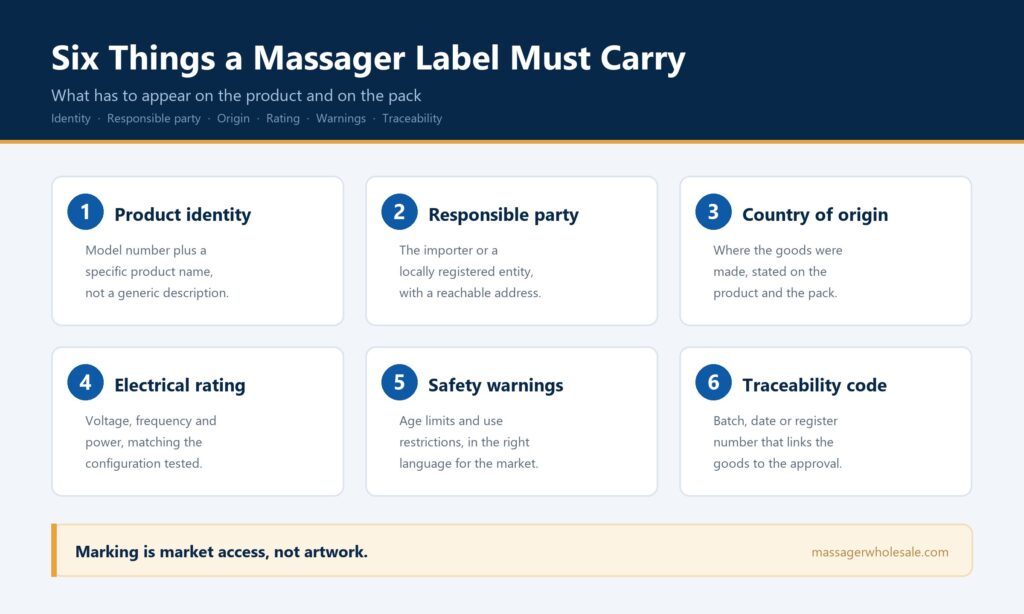
The core elements are common to both markets: product identification with a model number, the name and address of the responsible party, country of origin, electrical rating, safety warnings, and a traceability code. Two are worth expanding.
Identification must be specific. A generic description such as “massage device” does not identify a product for marking purposes. The label should carry the same model number as the test report and the certification, so an inspector can match label, product and file without interpretation.
The responsible party must be reachable locally. In both markets the approval is normally held by a locally registered entity. A label carrying only an overseas factory address leaves a consumer or an officer with nowhere to take a problem.
Malaysia adds separate rules for pre-packaged goods under a 2023 trade descriptions order: a specific product indication, the nominal quantity in the specified units, a count expressed in numbers, and the name and address of the wholesaler, producer, manufacturer or importer. Marking must be legible, contrast with the background, use Bahasa Malaysia or English for imported goods, and meet minimum character heights stepping from roughly 2 mm to 6 mm.
Where the mark goes: the rule that catches importers out
A technically compliant product becomes a non-compliant sale here. Both markets require the mark on the goods before they are supplied, and neither treats it as something added later — but they differ on where.
| Malaysia | Singapore | |
|---|---|---|
| Authority | Energy Commission (Suruhanjaya Tenaga), with SIRIM QAS for the mark | Consumer Product Safety Office (CPSO) |
| Mark | SIRIM certification mark, issued under the applicable scheme | SAFETY Mark |
| Where it must sit | On the product body — not on the packaging alone | On the product or its packaging, in a prominent location |
| Plug requirement | — | Appliances with a 3-pin plug need two marks: one on the appliance, one on the plug |
| Unique identifier | Batch or certification reference, depending on the route used | Unique 8-digit registration number, checkable against the public register |
| Registered against | A certificate of approval valid for one year | A registration valid for three years |
The Malaysian rule is easy to miss: if a factory’s default is to print the mark on the retail carton, the goods arrive with it on the wrong surface. The instruction has to say product body, not packaging.
Singapore is more forgiving: the mark may sit on the product or the packaging. Its trap differs — an appliance with a three-pin plug needs two marks, each carrying an eight-digit registration number verifiable against the public register. A number that does not resolve is treated as no mark.
Manuals, inserts and language
The manual is a compliance document, not a courtesy. Malaysia accepts Bahasa Malaysia or English; Singapore expects the user manual and the supporting technical documentation in English. Three rules follow:
- One English manual covers both markets. A bilingual English and Bahasa Malaysia manual is the lower-risk choice if the goods will sit on Malaysian retail shelves.
- Match the registered configuration — rated voltage, plug type and model number, not a predecessor’s specification.
- Treat inserts as part of the file. Warranty cards, registration cards and warning sheets belong with the label, not added at the printer.
Retail box versus e-commerce packaging
One product often ships in two packs, and the marking obligation follows the goods rather than the channel.
| Retail box | E-commerce carton | |
|---|---|---|
| Priority | Shelf mechanics and product information | Transit survival and fulfilment |
| Must carry | Barcodes, product image, specifications, warnings, a visible mark | Adequate board strength and a tamper-resistant seal |
| Common failure | The mark ends up where handling obscures it | The shipping label covers information the product must display |
| Artwork changes | Cosmetic changes generally need no re-certification, but do require updating the technical file | Same |
What unites them is that the artwork is tied to what was registered. Cosmetic changes — graphics, colours, layout — generally do not require fresh certification, but do mean updating the technical file. A change touching a safety-relevant component belongs with the certification body. Where the line falls is a judgment for the authority in each market, so ask before the print run rather than after.
Red flags in label and packaging artwork
- The certification mark appears only on the outer carton, with nothing on the product itself
- A SAFETY Mark has no readable eight-digit number, or the number does not resolve on the public register
- The named responsible party is the overseas factory, with no locally registered entity
- The manual is supplied in one language only, in a market that expects another
- The rating plate shows a voltage that does not match the configuration that was tested
- The model number differs between the label, the manual and the certification file
- The mark is placed as a low-resolution graphic rather than produced to the required specification
- Packaging changes are described as “just artwork”, with nobody checking whether they are cosmetic
None of these proves bad faith on its own. Together they describe a label that cannot be reconciled with the file — and reconciliation is what an inspector, a marketplace or a major retailer will attempt.
FAQ
Does the SAFETY Mark go on the product or the box?
In Singapore it may sit on the product or its packaging, as long as it is prominent. Appliances with a three-pin plug require two marks — one on the appliance, one on the plug.
Can the overseas factory hold the certification?
In both markets the approval is normally held by a locally registered entity. The factory supplies test reports and technical files; the application is made locally.
Which language does the manual have to be in?
Malaysia accepts Bahasa Malaysia or English for goods of foreign origin; Singapore expects the manual and technical documentation in English. For Malaysian retail shelves, a bilingual manual is lower-risk.
Can I change the packaging after the product is registered?
Cosmetic changes to graphics, colours and layout generally do not require re-certification, but the technical file should be updated. Changes affecting safety-relevant components should be raised with the certification body before production.
What happens if the label is wrong?
In Malaysia, unapproved or unlabelled equipment can be seized, removed from sale or disposed of. In Singapore, supplying controlled goods without a valid registration and SAFETY Mark carries a fine of up to S$10,000, imprisonment of up to two years, or both. In both markets the goods are unsaleable until corrected.
Where this leaves you
Labelling is part of market access, not design. Settle the market first, decide what the label must carry and where the mark sits second, and only then release artwork — because a produced carton is an expensive place to discover a marking rule. The quality and compliance documents a supplier should hand over cover much of this ground, and our contact page is the fastest way to reach us about a specific program. The frequently asked questions cover the commercial terms alongside these requirements.