
A massager warranty is the only clause that gets used after the money has changed hands. It is also the one buyers read last, usually on the morning the first faulty unit comes back from a retailer.
The problem is not whether a supplier says “12 months” — most do. It is that four separate numbers sit behind that sentence, and a clause that leaves any of them open resolves the argument in the supplier’s favour. This guide covers what to fix in writing: the numbers, the start date, what voids a claim, how a return runs, and who pays the freight.
A warranty is not a returns policy
Three different failures get mixed into one conversation, with different obligations.
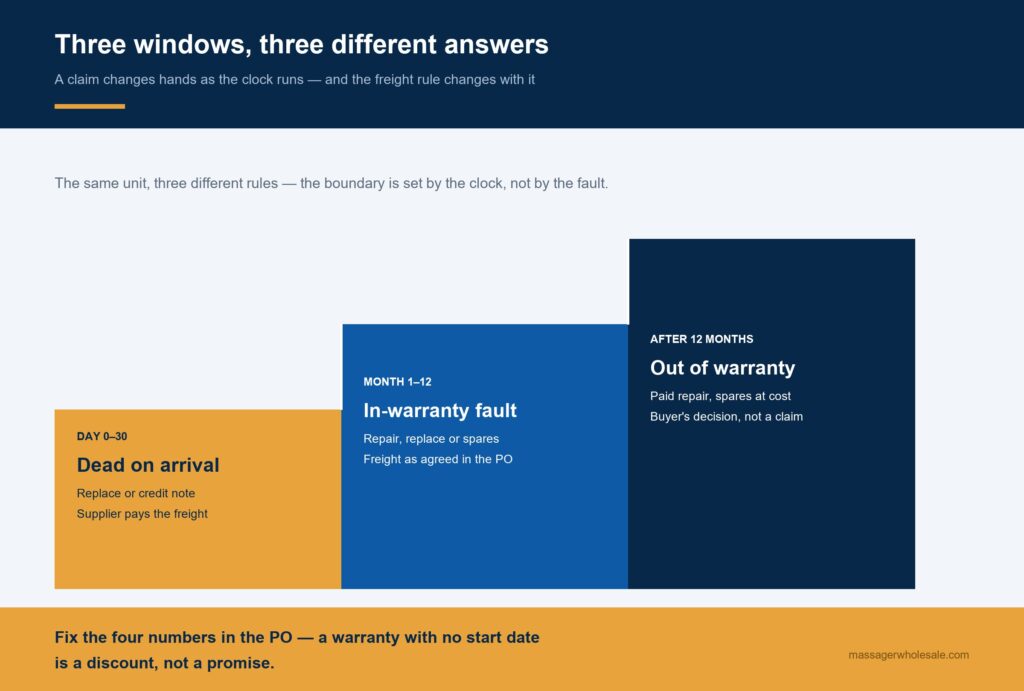
Dead on arrival is a unit that does not work out of the carton. It is a quality escape, not wear, and belongs on a short clock with no diagnostic argument.
Early-life failure is a unit that works for six weeks and then stops — what the warranty period is for, and where defect rate becomes visible.
Wear and consumables — pads, straps, charging contacts — are normally excluded. If the exclusion is not written down, every claim becomes a negotiation.
A warranty covers defects in materials and workmanship for a defined period. It does not create a right to return unsold stock, and it does not override the consumer law of the destination market, which may give end users longer rights — that second layer cannot be contracted away.
The four numbers to fix in the purchase order
| Number | What it decides | Common position |
|---|---|---|
| Warranty length | How long a defect claim is accepted | 12 months from shipment |
| Start date | Which event starts the clock | B/L date, or arrival |
| DOA window | How fast a dead unit is replaced | 15–30 days from arrival |
| Spare parts allowance | Whether small faults are fixed locally | A negotiated ratio of units or order value |
Each is negotiable and each costs the supplier money, which is why an open clause defaults to the cheapest reading. Put all four in the PO, not in an email.
The start date decides who pays
Twelve months from the bill of lading is the most common position, and the least favourable to the buyer: a sea shipment to Southeast Asia takes three to five weeks, and time in customs and in the buyer’s warehouse is invisible to the clause.
Three options exist:
- B/L date. Simple and verifiable; the shipment absorbs part of the warranty.
- Arrival date. Fairer, but needs a defined evidence point — customs entry or delivery note — or the date becomes arguable.
- First sale to an end user. Rarely accepted: the supplier cannot see it.
The practical middle is a B/L start plus a DOA window from arrival: transit stops consuming the period in which a dead unit is the supplier’s problem, and the main warranty stays on a date neither party can dispute.
What voids a claim
Exclusions are legitimate; undisclosed ones are not. The question is whether the list exists before the first claim or is invented during it.
- Water ingress, drops, or heat damage from a charger outside the rated input.
- Operation outside the rated voltage and frequency on the label.
- Repair or modification by anyone other than the supplier or an authorised service point.
- Units without a serial or lot number, which removes the ability to trace the batch.
- Damage in transit claimed as a warranty fault — that is a freight insurance claim, with its own deadline.
One exclusion deserves separate attention: a clause voiding the warranty if the packaging is opened. Inspectors open cartons before shipment; unreconciled with the inspection process, it lets the supplier void the warranty precisely when it is needed.
How an RMA should run
A return merchandise authorisation is a process, not a permission. Five steps, each with an output:
- Claim. One form: quantity, lot number, photos and a short video. Without the lot number there is nothing to check against production records.
- Triage. The supplier classifies the fault as known, batch-related or user-induced. Most disputes die here, so the step needs a stated response time.
- Disposition. Credit note, replacement or spare part — the choice should follow the fault, not the freight cost.
- Return or scrap. For a low-value device, shipping a faulty unit back to China often costs more than the unit; scrap-and-credit against photographic evidence is cheaper for both sides.
- Root cause. A short report on what failed and what changed — the only step that lowers next year’s claim rate, and the first one suppliers drop.
Spare parts usually beat a longer warranty
A longer warranty sounds like a concession and behaves like a liability: every small fault still travels across a border.
A spare parts allowance changes the economics. A percentage of units shipped as spares lets the buyer replace a strap or a charging contact in a day, at local cost, without an international shipment. The ratio is negotiated — a percentage of units, of order value, or a fixed count per container — and is usually cheaper for the supplier than a longer period.
Two conditions make it work: the spare must be user-replaceable without special tools, and serial numbers must be recorded as parts are consumed.
Who pays the freight
This clause decides the real cost of the warranty, and it is frequently left blank.
Return freight from Singapore or Malaysia to China can exceed the unit price. Three allocations are common:
| Route | Who pays | When it makes sense |
|---|---|---|
| Return both ways | Buyer, then seller credits | High-value units, repairable faults |
| Replacement shipped free, faulty unit scrapped | Seller | Low-value units, clear defect |
| Credit note without return | Seller | Small quantities, photographic evidence accepted |
For a device in this price band, the third route is usually cheapest for both sides; the second is fastest for the buyer’s own customer. Either way, the clause should say who pays freight on a rejected claim — the case that ends in an argument.
Red flags in a warranty clause
- No start date, or a start date that depends on an event the buyer cannot document.
- “Lifetime warranty” with no definition of lifetime.
- Coverage of “manufacturing defects” with no test method, so every claim becomes opinion.
- A claim window measured from the invoice date rather than shipment or arrival.
- No response time for triage — a queue with no end.
- Warranty void if the carton is opened — in direct conflict with pre-shipment inspection.
- Every faulty unit returned at the buyer’s cost, which quietly prices the warranty at zero.
What this means for your next order
Write the four numbers, the RMA timeline and the freight allocation into the PO, and reconcile the exclusions with your quality inspection plan. A warranty that contradicts the inspection process is worse than none, because it can be voided precisely when it is needed.
If the defect rate is a batch problem rather than a design problem, the fix sits upstream: the supplier selection stage, the documents that support compliance, and the import steps that decide whether the batch arrives in a condition the warranty can cover at all. Because the clock starts at shipment, the trade term you agree sets the start date as much as the contract does.
FAQ
How long is a massager warranty usually?
Twelve months from shipment is the usual starting point. Consumer law in the destination market may give end users longer rights; that layer sits outside the B2B contract.
Does the warranty start on the B/L date or on arrival?
The B/L date is the most common position because neither party can dispute it. A DOA window from arrival is the usual compromise, so transit does not eat the period when a dead unit is the supplier’s problem.
Who pays return freight for a warranty claim?
It depends entirely on the clause. Low-value units are usually handled by credit note or free replacement with local scrapping; returning every unit to China at the buyer’s cost often exceeds the claim.
Can I take spare parts instead of replacements?
Yes, and often the better trade: faults get fixed locally in days rather than weeks, provided the parts are user-replaceable and the buyer tracks which serials consumed them.
Does opening the carton for inspection void the warranty?
It should not, but such clauses exist. Name the inspection process in the warranty section, so pre-shipment checks cannot be treated as unauthorised tampering.