An inspection is a decision point, not a repair. By the time a massager order is 80 percent packed, every unit of production cost has already been spent. The inspection tells you whether that money produced goods you can sell — and it does so while the container is still on the factory floor, the only moment when the supplier still has to answer for the result.
This guide covers massager quality inspection from the buyer’s side: how to define acceptable before production, which checkpoints to book, what to check on a massage device, how to read an AQL sampling plan, and when a third-party inspector earns its fee. It sits downstream of choosing a supplier and of the quality and compliance documents you should have collected first.
Define acceptable before anyone inspects anything
The most common dispute in inspection is not whether a defect exists. It is which class it belongs to: a two-millimetre print offset on a control panel is a cosmetic note to one buyer and a rejected lot to another. Decide it before the goods exist, or you decide it under pressure on inspection day.
Settle three things in writing before the first unit is assembled:
- An approved sample. One physical unit, signed and dated, held by both sides. Where the destination market requires a registered model, it should match the approved configuration exactly.
- A defect classification. Critical, major and minor, each with examples drawn from your product rather than a generic list. Critical means unsafe or illegal, major means unsellable or likely to be returned, minor means visible only on close inspection.
- The acceptance limits. The AQL for each class, and the escalation you will apply if a lot fails.
Write all three into the purchase order. A report is only as useful as the criteria it measures against, and a supplier who has signed those criteria cannot argue the classification later.
Three checkpoints, three different jobs
Most importers book a single inspection and hope it is enough. The three checkpoints catch different problems, and the later a fault is found, the more it costs to correct.
| Checkpoint | When | What it catches | Cost of finding it here |
|---|---|---|---|
| First article | Before mass production, on tooling samples | Wrong dimensions, material or colour | One unit |
| During production | 20–50 percent complete | Systematic faults: noise, pressure loss, loose fit | Rework on a running line |
| Pre-shipment | 100 percent produced, 80 percent or more packed | Quantity, workmanship, function, packing, marks | Rework at the destination |
The arithmetic is what makes the early checkpoints worth booking. A fault corrected during production costs the price of the correction. The same fault found after the container lands carries freight, duty, storage and a return leg — and it arrives after the supplier has been paid in full. The gap is routinely described as a factor of ten to twenty.
What to check in massager quality inspection
A generic checklist covers appearance, dimensions, function, packing and quantity. It will not tell an inspector what tends to go wrong on a massage device. These six areas are where failures concentrate.
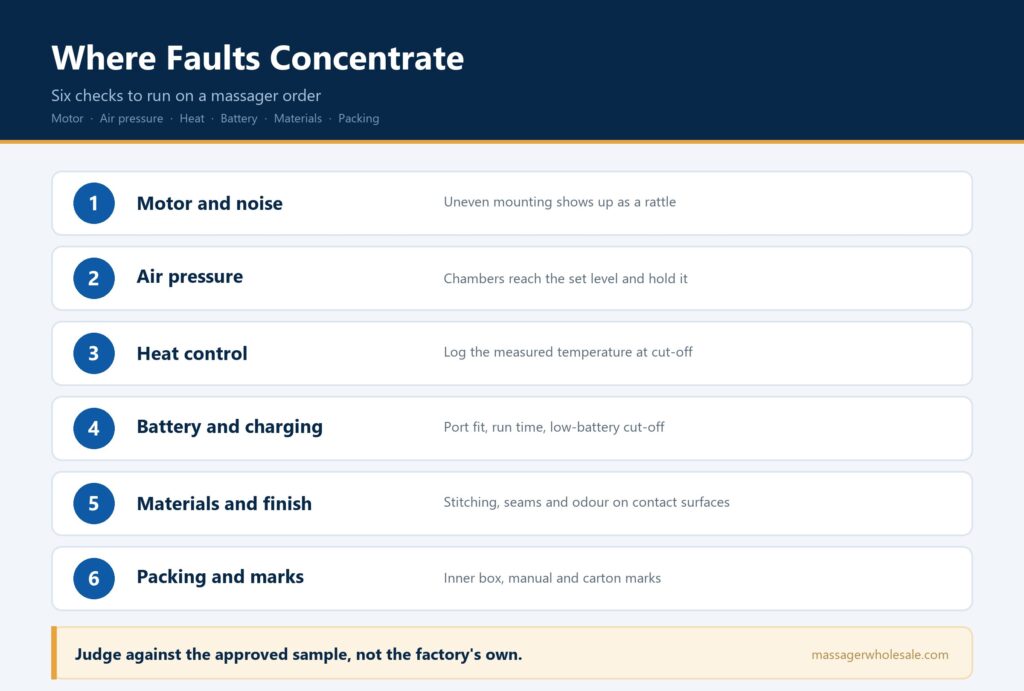
- Motor and noise. Run every sampled unit and listen. A misaligned or loosely mounted motor produces a rattle the customer notices immediately, and the fault is usually batch-wide because it comes from one assembly station.
- Air pressure. On air-pressure models, check that the chambers inflate to the specified level and hold it. A slow leak shows as a weak cycle rather than a dead unit, so it survives a visual check.
- Heat control. Confirm the heating element reaches its target range and the cut-off works. Record the actual temperature, not whether the unit felt warm.
- Battery and charging. Check the charging port for fit and wobble, confirm the stated run time on a full charge, and verify the low-battery cut-off.
- Materials and finish. Inspect the stitching, seams and adhesive lines on the contact surfaces, and smell the unit out of the bag. Odour is a common return reason in this category and does not photograph well.
- Packing and marks. Verify the inner box, the manual and the carton marks against the packaging and labelling requirements for the destination market, not against last season’s artwork.
How to read an AQL sampling plan
Sampling plans come from ISO 2859-1, published in the United States as ANSI/ASQ Z1.4. You choose the lot size, inspection level and the AQL for each defect class; the table returns a sample size with an accept and a reject number.
| Lot size | Sample at level II | Major accept / reject (AQL 2.5) | Minor accept / reject (AQL 4.0) |
|---|---|---|---|
| 501–1,200 | 80 | 5 / 6 | 7 / 8 |
| 1,201–3,200 | 125 | 7 / 8 | 10 / 11 |
| 3,201–10,000 | 200 | 10 / 11 | 14 / 15 |
| 10,001–35,000 | 315 | 14 / 15 | 21 / 22 |
An order of 5,000 units is therefore inspected at 200 pieces, and the lot passes if the sample contains no critical defect, ten or fewer major defects and fourteen or fewer minor ones. Four settings matter:
- Critical is zero. Safety and regulatory failures are not sampled to a percentage; one finding fails the lot.
- Level II is the default. Move to level III, or to tightened inspection, for a new supplier or a new tool.
- AQL is a decision rule, not a quality target. Passing an AQL 2.5 plan does not mean the lot contains 2.5 percent defectives; it means the sample fell within the accept number.
- Inspection is not compliance. A lot can satisfy every AQL limit and still breach a marking or certification rule in the destination market.
Third-party inspector or your own team
An independent firm sends a trained inspector to the factory, works from your specification rather than the supplier’s, and issues a photographed report with a pass, hold or rework recommendation. It bills per man-day, so the cost is predictable but real.
Handling it in-house works when you or your staff can attend the factory, hold the approved sample and measure against it without relying on the supplier’s equipment. What does not work is treating the factory’s own QC report as a substitute. That report is a production record, not independent evidence, and it is produced by the party whose work is being judged.
Red flags in an inspection report
- No photographs, or only photographs of sealed cartons
- The sample was drawn by the factory rather than at random
- Defects are counted but never classified
- The result line reads “pass” with no defect numbers behind it
- The inspection ran before 80 percent of the goods were packed
- Dimensions were checked against the factory’s own sample rather than the approved one
- The report is dated after the container was loaded
Any one of these does not prove bad faith. Together they describe an inspection that cannot support the decision it was booked to support.
FAQ
What happens if the lot fails?
The right option depends on the defect class. Critical findings normally mean rework or rejection. Major defects can be reworked, sorted, or accepted at a price adjustment. Minor defects are usually settled commercially, against a limit agreed in advance.
Do I need an inspection on every order?
No. Book them where exposure is highest: first orders, new suppliers, new tooling, high-value runs and complex assemblies. A supplier with a long clean record can move to reduced inspection with periodic re-checks.
How long does a pre-shipment inspection take?
A single-day visit covers most consumer-goods orders, with the report issued within one business day. Larger lots take longer, so book against your shipping date rather than after the goods are ready.
Can the factory’s QC report replace an inspection?
No. Factory QC is a process record kept by the producer. It shows that process control exists, but it is not independent verification and will not support a claim against the supplier the way an independent report does.
Which AQL values should I use?
For consumer goods the common starting point is zero for critical, 2.5 for major and 4.0 for minor. Raise it for a new supplier, a new tool, or a product with high return exposure — moving major defects to 1.5 or 1.0 is common.
What this means for your next order
Inspection works when the standard is set before the goods exist, the checkpoints are booked early enough to change the outcome, and the report is read for defect numbers rather than for the result line. The cost of running it properly is small against the cost of finding the problem at the destination. If you are setting up inspection for a specific order, our contact page is the fastest way to reach us.