Two buyers can agree the same unit price, the same quantity and the same delivery month, and still end up with very different landed costs. The difference is rarely the supplier. It is the three-letter Incoterms rule sitting in the quotation.
This guide covers the commercial mechanics of a massager order from the buyer’s side: what each Incoterm actually transfers, which one suits a first order, how payment terms should be structured around production and inspection, who carries the currency risk, and which requests should stop a deal. It assumes you have already chosen a supplier and worked through the import requirements for your market.
A term fixes four things, not one
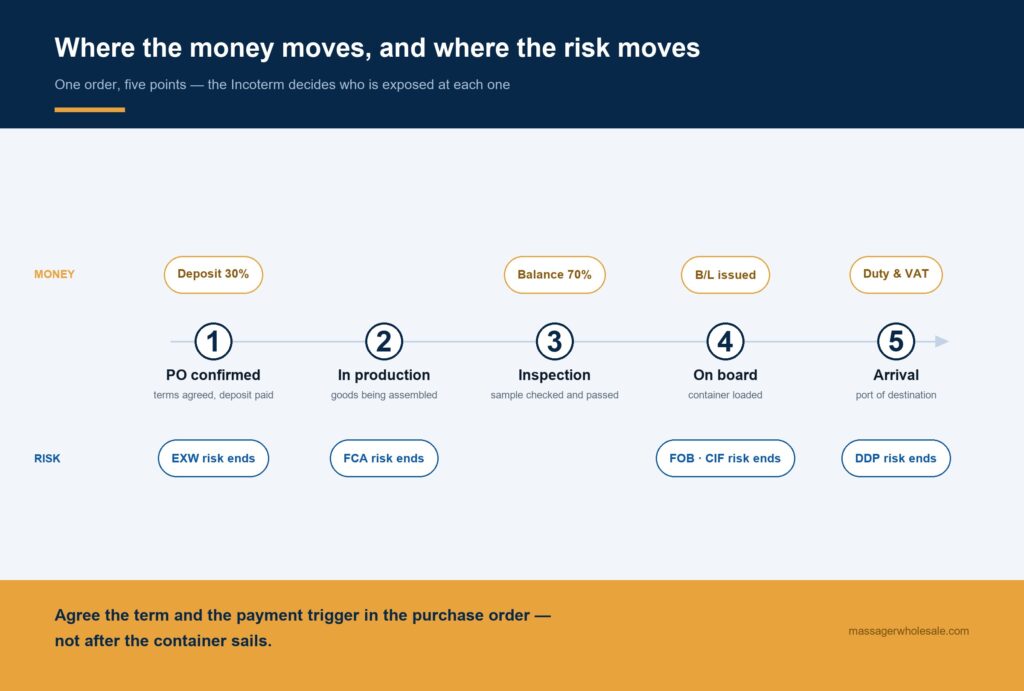
Most buyers read a quotation as price plus delivery. An Incoterm decides four separate questions, and they do not move together:
- Who arranges carriage — who books the freight and pays for it.
- Who bears the risk in transit — the exact moment a damaged unit stops being the seller’s problem.
- Who clears export — the Chinese side of the border.
- Who clears import and pays duty — the destination side, including tax.
Confusing these is the root of most Incoterm disputes. A seller quoting CIF has paid the freight, but the risk left the seller when the goods went over the ship’s rail. The buyer owns a loss at sea even though the seller booked the vessel and bought the cover.
The five Incoterms a first order actually meets
Quotations for massage devices usually come back in one of five terms. The differences matter more at small volumes than at container scale, because fixed fees do not shrink with the order.
| Term | Seller arranges | Risk passes | Typical use |
|---|---|---|---|
| EXW | Nothing; buyer collects at the premises | When goods are made available at the seller’s site | Rarely workable for overseas buyers |
| FCA | Export clearance, delivery to the carrier | When goods are handed to the carrier | Air, courier and consolidated freight |
| FOB | Export clearance, goods loaded on board | When goods are on board the vessel | Sea freight, port to port |
| CIF | Freight and minimum insurance to the port | When goods are on board the vessel | Sea freight with freight prepaid |
| DDP | Everything, including import duty | At the named destination | Buyers with no import entity |
Which term fits a first massager order
EXW looks cheapest and is usually the most expensive. Under EXW the buyer handles Chinese export clearance, which a first-time importer has no licence or registration to file. The goods still move on the supplier’s paperwork, so you pay for a service you cannot control — against an invoice that understates the real cost.
FOB is the working default for sea freight. The seller clears export and loads the container; you keep the forwarder, the route and the insurance. Control of the forwarder is worth more than it looks — it is the difference between knowing where your container is and asking someone to check.
FCA, not FOB, is the correct term for air freight. FOB applies only to sea and inland waterway carriage. A quotation offering FOB for an air shipment is describing a term that does not cover the mode, which is a fair signal of how carefully the rest of the quotation was built.
DDP is convenient and opaque. It removes the paperwork and folds the duty into one number. For a buyer with no import entity it can be the only workable route. For a buyer who will register the product locally, it usually means duty was declared at a value you did not choose and the import record is not in your name.
Payment terms: what the money is actually paying for
Payment terms are not a financing detail. After the deposit leaves, they are the buyer’s only remaining lever.
| Method | Protection for the buyer | Cost and friction |
|---|---|---|
| 30/70 telegraphic transfer | Balance held until documents or inspection | Bank fees only |
| Letter of credit | Bank pays against compliant documents | Issuing cost and strict document matching |
| Platform escrow | Funds released on an agreed milestone | Limited to the platform’s order flow |
A letter of credit is the standard answer for large orders between strangers. At 500 to 5,000 units it is usually disproportionate: issuing fees, amendment fees and document discipline cost more than the risk they remove. Most first orders here run on a deposit and a balance.
Structure the balance around inspection, not around shipping
A balance due “before shipment” pays the supplier in full while the goods are still in their building and you have no independent evidence of what is in the cartons. A balance due against the bill of lading copy is better, because the goods exist and have been loaded — but a copy can be issued before anyone has opened a carton.
The structure that holds is a balance released after a passed pre-shipment inspection, booked against the shipping date rather than after the goods are ready. Two clauses make it enforceable: the inspection standard goes into the purchase order, and the balance is payable on the report, not on a verbal confirmation.
Suppliers often resist this, usually over cash flow rather than principle. A workable middle is a small retention — 20 to 30 percent of the balance — released against documents, with the rest tied to the report.
Currency: who owns the exchange rate
Quotations arrive in US dollars; the buyer pays in ringgit or Singapore dollars. Someone carries that gap.
- A USD quotation puts the currency risk on you between order and payment. Over a 90-day production cycle, a two percent move is not unusual.
- A local-currency quotation moves the risk to the supplier, who prices it in. The rate is usually worse than the market and sits where you cannot see it.
- A fixed-rate clause is worth asking for above a few thousand units: agree the rate on the order date and let the difference settle at the balance.
None of these is universally correct. What matters is that the rate and the fixing date are written down, rather than discovered on the invoice.
Red flags in a payment request
- Payment to a personal account, or to an account in a third company’s name
- A bank account that changed after the order was confirmed
- Full payment demanded before any inspection or factory visit
- A quotation with no named Incoterm at all
- “FOB” quoted for an air shipment
- Duty included in the price with no breakdown and no import record in your name
- A discount offered for paying outside the agreed terms
Any single item can have an innocent explanation. Together they describe a transaction where the paperwork will not protect you.
FAQ
Which Incoterm should I ask for on a first order?
FOB for sea freight and FCA for air. Both keep the freight, the insurance and the import record with you, while export clearance stays with the party that can file it.
Is EXW ever the right choice?
Only if you already have an entity or agent able to clear exports from China. Without that, the term describes a responsibility you cannot discharge, and the goods will still move on the supplier’s documents.
Does CIF include insurance?
It requires minimum cover, normally Institute Cargo Clauses C, which excludes losses many buyers assume are covered. If the cargo matters, buy your own cover on FOB terms.
Can I pay the balance after the goods arrive?
Rarely on a first order. A supplier with no trading history will not accept it, and a supplier who does is carrying a risk that is priced somewhere else. An inspection-linked balance is the realistic middle.
Who pays import duty under DDP?
The seller, contractually. In practice the duty sits inside the unit price, declared at a value the seller chose, and the import record is in the seller’s or agent’s name. If you need that record for registration or tax, DDP works against you.
What this means for your next order
A term is only useful if both sides read it the same way. Put the Incoterm, the payment trigger and the currency into the purchase order, in that order, and most of the arguments that follow a shipment never start. Wholesale terms for this category, including the deposit split and MOQ, are set out on the wholesale program page; if you want commercial terms reviewed against a specific production schedule, the contact page is the shortest route.