Massagers have moved from a novelty gift into mainstream wellness retail, and China remains the dominant source for both finished units and components. The difficult part of importing them is rarely the price. It is market access — whether the model you are buying is allowed to be sold in your market at all, and whether the paperwork that proves it exists.
This guide covers what to settle before an order: classification, what Malaysia and Singapore each require, the documents to collect, and what to check before shipment.
Start with the destination market, not the supplier
Quotations arrive faster if you ask for a price first, but they will not be comparable. Settle six things before you contact anyone:
- Which market. Malaysia and Singapore run separate regimes — approval in one does not carry to the other, and the same product can carry a different tariff code in each.
- Whether the product is a controlled item. Massage appliances with a motor connected to the supply fall within mandatory schemes in several markets. Confirm the current list rather than assuming your model is out of scope.
- Power and plug configuration. Singapore uses Type G plugs at 230 V / 50 Hz. A model built for a 110 V market needs a different electrical build, not a travel adapter.
- Label and manual language. English is expected in both markets, and certain products also require Bahasa Malaysia. Ask what the factory prints as standard, not on request.
- Sales channel. Marketplaces, retail shelves and pharmacy chains inspect documentation differently — the more visible the channel, the more complete your file must be.
- Who holds the approval. Normally a locally registered entity rather than the overseas factory — covered in more detail below.
Know the classification before you argue about duty
Massagers are generally classified under HS heading 9019.10 — mechano-therapy appliances and massage apparatus. The heading divides into electrical vibratory-massage apparatus and a residual category:
| Subheading | Scope | Typical products |
|---|---|---|
| 9019.10.10 | Electrical vibratory-massage apparatus | Handheld, cordless and mains-powered massagers |
| 9019.10.90 | Other massage apparatus | Non-electrical and residual categories |
The first six digits are standardised internationally; the digits after that are set nationally, so Malaysia and Singapore each publish their own full code. The same product can therefore carry a different full code in each market, and the code determines both the duty rate and whether preferential treatment is available.
Duty treatment also depends on origin rules and on how the local customs authority rules on your goods. Ask your supplier which code they normally declare, confirm it against the importing market’s current schedule, and treat any rate quoted in a chat message as indicative rather than final.
Certification: Malaysia and Singapore differ
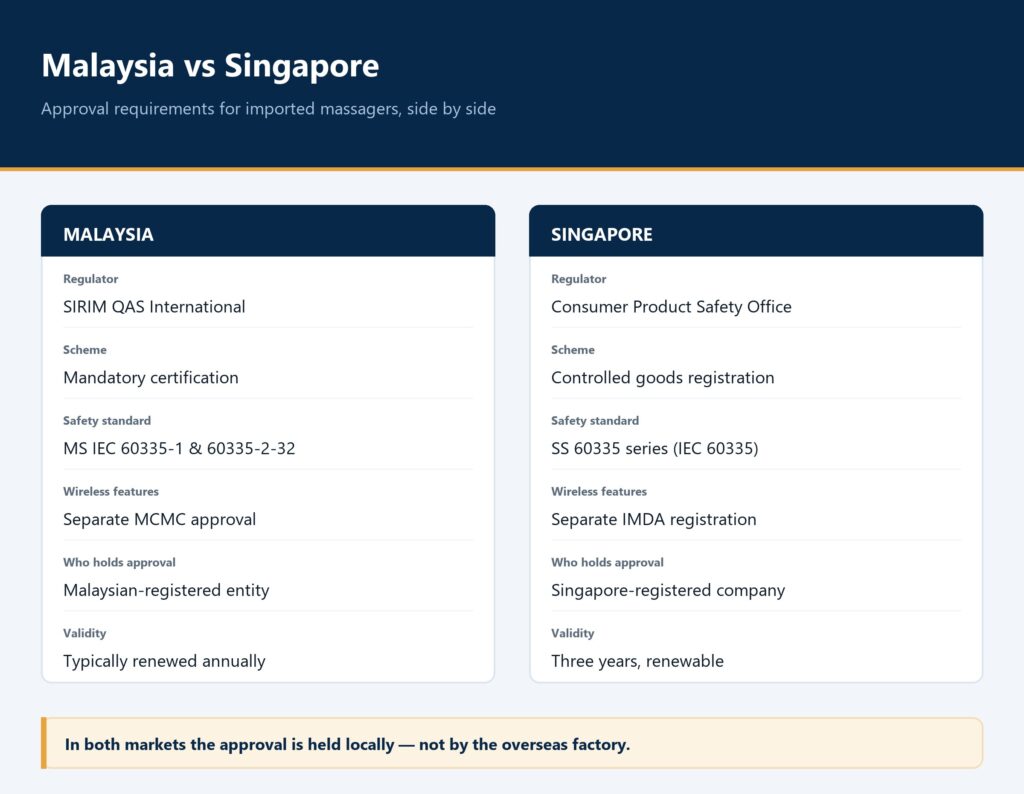
Both markets require approval before a mains-powered massager can be lawfully supplied, but the schemes are not interchangeable.
| Malaysia | Singapore | |
|---|---|---|
| Authority | SIRIM QAS International, with electrical safety registration under the Energy Commission | Consumer Product Safety Office (CPSO) |
| Scheme | Mandatory certification for massage appliances with a motor connected to supply | Controlled goods must be registered and carry the SAFETY Mark |
| Safety standard | MS IEC 60335-1, with MS IEC 60335-2-32 for massage appliances | SS 60335 series, based on IEC 60335 |
| Wireless features | Separate MCMC type approval | Separate IMDA equipment registration |
| Certificate holder | Must be a Malaysian-registered entity; overseas factories appoint a local representative | Must be a Singapore-registered company |
| Validity | Approvals are typically annual and need renewal | Registration runs three years and is renewable |
| If not complied | Goods can be held at customs, with fines and possible prosecution | Fines and imprisonment; goods cannot be lawfully supplied |
Three points catch importers out more often than the technical requirements themselves.
The certificate holder is not the manufacturer. In both markets the approval is normally held by the local importer or an authorised local representative. The factory supplies technical files and test reports; the local entity applies. The useful question is not whether a supplier holds a certificate, but who will hold the approval for your import.
Wireless is a separate approval. Bluetooth or Wi-Fi needs radio approval on top of electrical safety approval, through a different agency and on a separate timeline. A model with no wireless features avoids that step entirely.
Validity is not permanent. Renewal dates fall due independently of your ordering cycle, and tests that fall outside the scheme’s acceptance window have to be repeated.
Documents to collect before you place a deposit
- Business registration document for the factory, showing the registered scope of business
- Letter of authorisation naming your local entity as representative, where one is involved
- Test reports that identify the exact model numbers you intend to sell, with issue dates
- Bill of materials, plus circuit diagrams where the approval body requests them
- User manual in the required language or languages
- Artwork for the product label and rating plate
- Quality management system certificate, where the scheme requires one
Typical quality and compliance documents a supplier can share include test reports, material declarations and declaration letters. Two habits remove most of the risk: confirm that every document names the same model number you are buying — not a predecessor and not a variant — and check issue dates, since a report outside the scheme’s acceptance window has to be repeated.
Check the shipment before it leaves the factory
Compliance problems found at the destination port are expensive: storage, re-testing, rework or return freight, with the goods unavailable throughout. The low-cost moment to find them is before loading.
What a pre-shipment inspection should cover:
- Safety-relevant build — earthing, insulation, creepage distances, cord anchorage and strain relief
- Consistency with the approved sample — same production line, same components, same tolerances
- Rating plate and labels — model number, rated voltage and power, manufacturer or importer identity, matching the approved artwork
- Functional behaviour — heat-up and cut-off behaviour, runtime, charging, control response
- Packaging and inserts — carton strength, barcodes, manuals in the correct language
- Sampling — agree the plan in advance and record defect classifications rather than negotiating after the report lands
For a first order, a pre-shipment inspection usually costs less than a week of demurrage.
Red flags in compliance claims
- Certificate images are cropped or blurred, or show a model number that does not match the quotation
- A certificate is described as covering “our whole range” without a model list
- Test reports fall outside the acceptance window of the scheme you are relying on
- The certificate holder is an entity you cannot identify or verify
- Wireless features are described as needing no approval
- The supplier offers to “handle everything” without naming the local entity that will hold the approval
None of these prove bad faith on their own. Together they describe a compliance chain that nobody can audit — and the audit is what a customs officer will ask for.
FAQ
What HS code do massagers use?
Massagers are generally classified under heading 9019.10, which covers mechano-therapy appliances and massage apparatus. The full code, and any duty treatment that follows from it, varies by importing market — confirm it against the local tariff schedule and with the local customs authority.
Do I need certification to import massagers into Malaysia?
Massage appliances containing a motor and connected to the power supply fall within Malaysia’s mandatory certification scope, administered by SIRIM. Confirm the current product list and applicable standards with the authority or a licensed local representative before placing an order.
Can the overseas factory hold the certificate?
In both Malaysia and Singapore the approval is normally held by a locally registered entity. The factory supplies technical files and test reports; the application itself is made locally, which is why the local partner matters more than the factory’s own certificate library.
How long does the approval process take?
It depends on the product and on how complete your documentation is. Expect weeks rather than days, and allow more time where radio approval is involved or a new test report is needed.
What if the massager has Bluetooth or Wi-Fi?
Wireless functions require separate radio approval, handled by a different agency in each market. A model without wireless features avoids that step entirely.
Where this leaves you
Compliance is cheaper to plan than to repair. Decide the market first, confirm the classification and the approval route second, and collect documents that name the exact model before any deposit is paid. If you are evaluating a specific massager program and want to work through the documentation requirements, our contact page is the fastest way to reach us — and the frequently asked questions cover the commercial terms, including how a wholesale program is structured.